





Introduction to Setting Up Your Company in Ireland
Registering an Irish company can be beneficial to companies looking to expand into the EU market. Setting up a company in Ireland means registering a private company limited by shares (LTD) with the Companies Registration Office (CRO). The process typically takes 10 to 12 working days. International founders can complete the process remotely, provided the company has a registered Irish office and at least one director resident in the European Economic Area (EEA), or have a bond arrangement. Ireland is the only English-speaking country in the EU. It also has one of the lowest corporation tax rates in the EU.
At Nathan Trust, we don’t just form companies, we build long-term partnerships that support our clients as they grow in Ireland and beyond. From choosing a structure to employee registration, we’ll work with you with everything you need to know to start strong.

Which Business Structure Should You Choose?
The first step to setting up a company in Ireland is selecting the right legal structure. This decision will shape how your business operates, your tax obligations and your level of personal liability. There are several types of company structures in Ireland, each with distinct advantages:
Private Company Limited by Shares (LTD)
A Private Company Limited by Shares (LTD) is the most common choice of company structure in Ireland. The benefits of an Irish limited company include personal asset protection, a low corporation tax rate (12.5%), and the opportunity for growth and expansion.
Designated Activity Company (DAC)
A Designated Activity Company suits businesses that want their permitted activities clearly defined and legally restricted from the outset. This often suits financial services entities has they are heavily regulated in regards to their activities.
Public Limited Company (PLC)
A Public Limited Company (PLC) is a company limited by shares that can offer its shares to the public (through share offerings & the stock exchange) — the main feature distinguishing it from a private company making its activities heavily regulated and complex.
Company Limited by Guarantee (CLG)
A Company Limited by Guarantee (CLG) is the structure of choice when profits need to be reinvested into the organisation's mission (charities & NPOs) rather than distributed to shareholders, since a CLG has no share capital or owners in the traditional sense.
Branch
A Branch is not a separate legal entity. It's an extension of a foreign (overseas) company registered to carry on business in Ireland. The foreign parent company remains fully legally responsible for everything the branch does. Often setting up a limited company is recommended for the full benefits of operating in the EU.

The 4-Step Company Registration Process
Choose a company name and registered office
Checking your proposed company name's acceptability before submission matters because the CRO can still direct a name change after registration if an objection arises. You can see if your proposed company name already exists by checking here. Every Irish Limited Company needs an Irish Registered Office address at the point of incorporation.
Appoint directors, shareholders, and a company secretary
Setting up an Irish limited company (LTD) means getting three roles right at the outset: directors, shareholders, and a company secretary.
Directors
A limited company requires at least 1 director (18+), who must be resident in an EEA state (European Economic Area). If this is not possible, companies can take out a Section 137 Bond which is valid for 2 years and renewable. They are responsible for fiduciary duties, passing resolutions and keeping accounting records.
Shareholders (Members)
A limited company needs at least one shareholder (max 149), who can also be the companies director. Shareholders can also corporate entities and not limited to persons.
Company Secretary
An Irish company secretary is mandatory, even for single-director companies though the director in this case cannot fulfill the role of company secretary. This person does not need to be an Irish resident but needs to be qualified for the role. They are responsible for CRO filings, managing meetings and keeping the company compliant. This role can be outsourced.
Simplest common structure: one EEA-resident (or bonded) director, one or more shareholders, and an outsourced/professional company secretary.
Making the right appointments at this stage is critical for compliance, good governance and long-term business success. Let our team guide you through it with confidence.
Draft and sign the Constitution
Under the Companies Act 2014, the constitution is a single unified document which acts as the internal governing contract between the company, its legal officers, and its shareholders. It articulates the share and pre-emption rights, clauses and contains details for shareholders, an independent witness and directors. The CRO requires wet signatures to be filed to be accepted.
File with the CRO and receive your Certificate of Incorporation
To file with the Companies Registration Office (CRO) in Ireland and obtain your Certificate of Incorporation, you will complete an electronic submission through the CRO’s online portal, CORE (Companies Online Registration Environment) of all the relevant documents you’ve created. The standard electronic incorporation fee via CORE is €50. Once approved, the CRO will issue a digital Certificate of Incorporation sent directly to your registered email address.
At Nathan Trust, our Corporate Governance team has extensive experience in assisting non-residents with Irish company incorporations. Our in-house tax team have assisted hundreds of companies in getting corporation tax and VAT registered, handled thousands of filings, while also assisting client with tax advice on an international level where required.
Irish Company Registration Requirements for Non-Resident and International Founders
The EEA resident director rule
Under Section 137 of the Irish Companies Act 2014, every company registered in Ireland must have at least one director who is resident in the European Economic Area (EEA). If your company does not have an EEA-resident director, you must put a Section 137 Non-EEA Director Bond (often called a Revenue Bond or Surety Bond) in place before the Companies Registration Office (CRO) will complete incorporation. Since 2021, the UK is considered outside the EEA. There is one other alternative to the Section 137 bond where you can engage a Nominee Irish Resident Director.

Can you register a company without visiting Ireland?
Yes, it is possible to register a company in Ireland without visiting the country, The entire process can be done remotely. Where wet signatures are required, you will need to send documents via registered post or courier. You can also set up a business bank account remotely using an online video call.
When using the Section 137 bond timing is essential. The bond needs to be coordinated with the incorporation of the company. It is recommended to use the same service provider to arrange the bond and process the incorporation. The Corporate Governance team at Nathan Trust have extensive experience incorporating Irish companies with Section 137 bonds.
Timeline to Register an Irish Company
When registering a company in Ireland, there are a number of processes that need to be correctly followed in order to bring the company to a point where it can trade. It’s important for all persons involved to understand the timelines clearly. When planning your business activities, it’s essential to be aware of these timelines.
New Company Incorporation Timeline Breakdown
| Phase/Action | Working Days | Operational Timeline Details |
| 1 - AML & Identity Verification | 1 | When registering a company in Ireland, there are a number of processes that need to be correctly followed in order to bring the company to a point where it can trade. It’s important for all persons involved to understand the timelines clearly. When planning your business activities, it’s essential to be aware of these timelines. |
| 2 - CRO Company Incorporation | 10-12 | Filing Form A1 and company constitution with the Companies Registration Office. Standard review and issuance of the official Certificate of Incorporation takes 10 to 12 working days. |
| 3 - Director PPS / VIF Number | 20-25 | Directors who own 15% or more of company shares must obtain an Irish PPS Number or VIF Number. This step is a prerequisite prior to submitting tax registration applications. |
| 4 - Revenue Tax Registration | 5-10 | Once PPS/VIF numbers are issued, the application for Corporation Tax, and Employer PAYE registration is processed with the Revenue Commissioners. |
Nathan Trust provides you with a one-stop-shop, offering services like Company formation, Tax registration and Tax advice, Company Secretary services, Accounting and Bookkeeping, Section 137 bonds, HR services, & Employer of Record services, all in one place with a personal team consulting you as your business grows and expands.
What to Do After Incorporation of Your Irish Company
New Irish Company Tax Registration (Corporation Tax, VAT, PAYE)
For Corporate Tax registration, directors with 15% or more shareholdings are required to hold a PPS number (PPSN) to allow the company register for corporation tax in Ireland, which can take 4-5 weeks. Once acquired, the company can apply for corporation tax which can take a further 1-2 weeks.
Registering an Irish company as an Employer (PAYE) takes approximately 1 week and VAT registration can take up to 8 weeks.
Opening an Irish business bank account as a non-resident
Opening a business bank account is an essential part of doing business in Ireland. You can choose between a pillar bank like Bank of Ireland, or a neo/digital bank like Revolut. While traditional pillar banks can take up to 4 weeks to open a business bank account, opening a Neo/digital bank account in Ireland can take less than 1 week.
Your personal consultant at Nathan Trust will assist you throughout the process, ensuring you have all the required documents prepared in can even appear with you during the call process of operning a Neo/digital bank account.
Your First Year Compliance as an Irish Company
Key Deadlines at a Glance
| Milestone | Applies to |
| 30 Days | Revenue Tax Registration (from commencing activity) |
| 2 Months | Share certificates issued |
| 5 Months | RBO filing |
| 6 Months | First annual return (no accounts) |
| 9 Months | First Corporation Tax return (from year end) |
| 56 Days | Every subsequent annual return (from ARD) |

Why International Founders Choose Ireland for Company Registration
EU market access post-Brexit
A great number of UK companies have chosen to set up new companies in Ireland since Brexit, which saw the UK leave the EU. Establishing a business in Ireland makes instant sense to UK companies. Ireland is an English-speaking country, with a familiar legal system, making it a far easier place to do business for UK residents. Additionally, the Common Travel Agreement between the UK and Ireland allows for easier travel for UK residents. When UK companies establish a company in Ireland, they can trade with the EU as they did before Brexit. If you're not in the UK you can read our comparisons of forming a company in Ireland vs the UK.
Low corporate tax rate + large double tax treaty agreement network
At 12.5%, Ireland has one of the lowest corporate tax rates in the EU. It has a large network of double tax treaties with other countries, with 75 currently in effect. If a resident of one of these 75 countries is a shareholder in an Irish entity, there are great tax benefits associated with receiving dividends. Typically, there is zero withholding tax on your dividends in Ireland if you are resident in a country that has a double tax treaty agreement with Ireland.
English-speaking, common-law jurisdiction with a straightforward registration process
Ireland is the only English-speaking country in the EU. Add to this the fact that it’s a common-law jurisdiction, and it makes it very attractive location, not only to UK residents as mentioned previously, but also to US, Canadian, Australian, New Zealand, and South African residents looking to expand their businesses into the EU.
Our Tailored Packages to Set Up Your Company
Your simple, compliant start in Ireland
Great Value

Standard Company Setup Package
Ideal for clients who need a compliant, CRO-registered Irish company with the core essentials covered:
- Full company incorporation
- Registered office address in Ireland
- Company secretary service
- Annual return preparation
- UBO register setup and AML compliance
Recommended

Full-Service Company Setup Package
Perfect for businesses ready to trade and scale in Ireland, with additional banking and tax registrations professionally managed:
- Everything in the Standard Package
- Business bank account setup (via trusted Irish banking partners)
- Corporation Tax registration
- VAT registration
- Extended AML support
Free Download
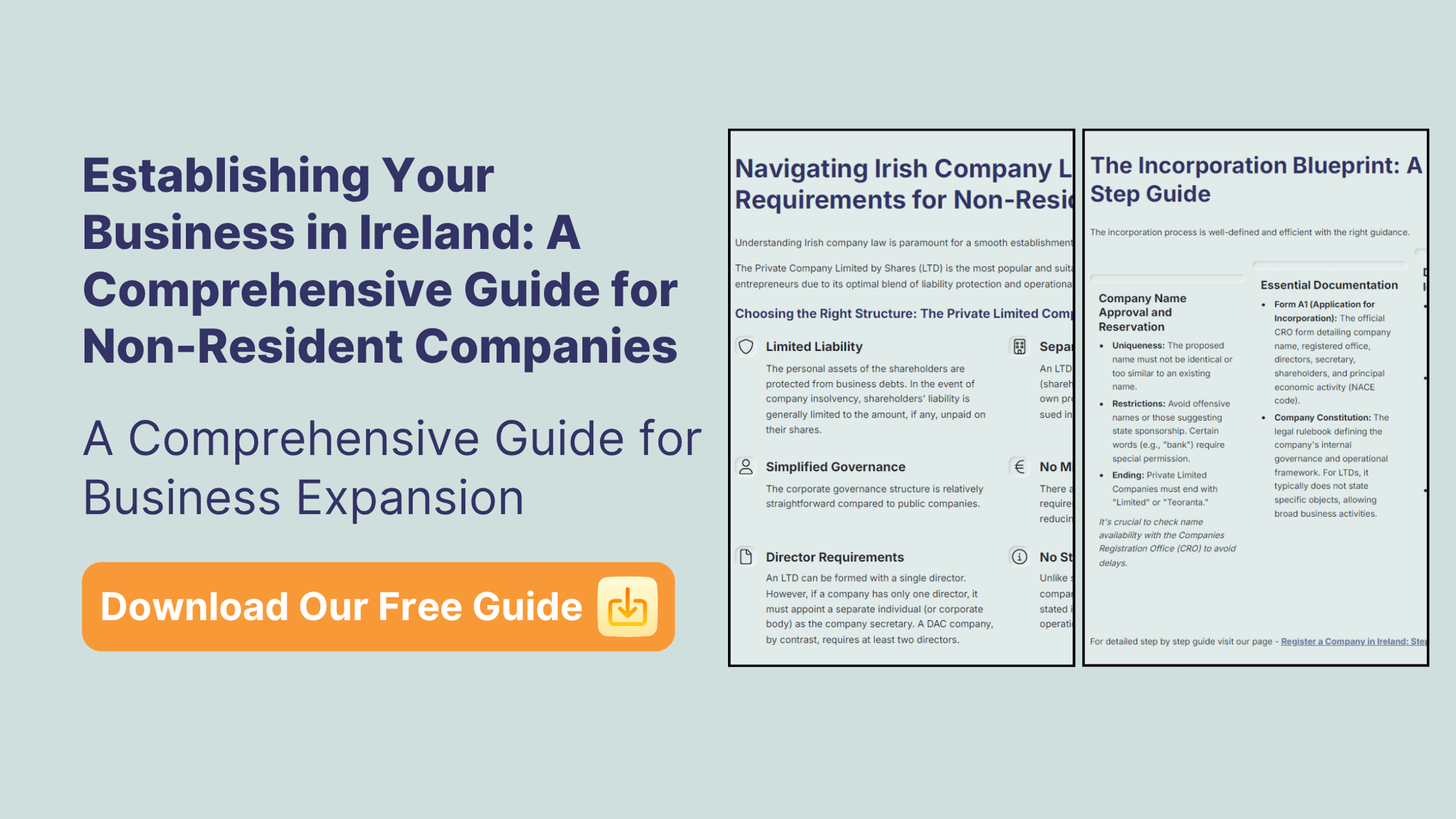
Company Creation Roadmap
Looking to set up a company in Ireland but unsure where to start?
This free checklist breaks down the 10 key steps to help you navigate the process with clarity. From documentation to CRO filing and tax registration, it covers all the essentials.
Download now and take the guesswork out of company creation in Ireland.
FAQs About Company Registration in Ireland
How to stay compliant when setting up a company in Ireland?

Can you have a single director company in Ireland?
How long does it take to set up a limited company in Ireland?
Do you need to visit Ireland to set up a limited company?
Do directors need to be residents to register a company in Ireland?
What tax rate will apply when setting up an Irish limited company?
Can you open an Irish limited company bank account as a non-resident?
How to stay compliant when setting up a company in Ireland?
Setting up a company in Ireland should always involve adopting a proactive mindset. Compliance is key in this respect, and responsibilities include:
-
Ensuring that all taxes and accounting statements are filed properly and in a timely fashion.
-
Becoming familiar with corporate tax rates.
-
Filing the proper financial statements.
-
Fraud risk management.
-
Consumer protection.
One challenge that many company owners face involves compliance guidelines that may be updated from time to time. Nathan Trust will keep abreast of the latest modifications so that you will never be caught off guard.Ireland does not entitle you to Irish residency.
Can you have a single director company in Ireland?
Yes, a Private Company Limited by Shares (LTD) in Ireland can have a single director, but it must also have a separate company secretary. This is a key difference compared to other company types in Ireland, which typically require a minimum of two directors.
At Nathan Trust, we offer nominee company secretary services, which can fulfil this role for clients who want to set up a single director/sole director company.
How long does it take to set up a limited company in Ireland?
It typically takes between five to 14 working days, depending on how quickly AML checks and signed documents are completed.
The process includes:
- Anti-Money Laundering (AML) checks (2.5 days).
- Signing and returning incorporation documents (1.2 days).
- CRO processing (3.5 days).
Directors with over 15% shareholding will also need a PPS number. Our team can help with that if needed.
Do you need to visit Ireland to set up a limited company?
No, your physical presence is not required in Ireland to incorporate a company, but some banks may require an in-person meeting. Signed application and identity documents can be sent by post in advance of your limited company setup. However, we always like to invite our clients to Dublin or Cork to meet us when possible.
Do directors need to be residents to register a company in Ireland?
No, directors do not need to be residents of Ireland to register a company. However, Irish company law requires that at least one director must be a resident of the European Economic Area (EEA).
It's important to note that this requirement is based on residency, not nationality. For example, an Irish citizen living in the United States does not meet this requirement unless they also reside in an EEA country. In this case, they cannot be the sole director of the company.
While it's not a legal requirement, appointing a director who resides in Ireland is often recommended for tax residency purposes.
If your company does not have an EEA resident to fulfil the requirement of having an EEA resident director, we can provide you with a Section 137 non-EEA Directors bond. You can also avail of a Nominee Director service for Irish company registration. We have a group of highly regarded professionals available to fulfil nominee director roles to ensure best practice in the compliance of your Irish Company.
What tax rate will apply when setting up an Irish limited company?
The corporate tax rate for a limited company in Ireland is currently 12.5%, among the lowest in Europe. The low corporation tax rate has been one of the primary reasons why global companies are interested in Ireland. As directors and business owners, it’s very important to know the tax rates before proceeding with any decision related to your Irish company. It’s a good opportunity for businesses to save a lot of money on their tax bills as well as ensuring they get the most out of their year-end revenue.
You might be able to avail of the 3-year tax exemption for startup limited companies in Ireland.
A study by PWC, "Paying Taxes 2020", ranked Ireland in first place for the ease of paying taxes. Ireland has double tax treaties (DTA) with 78 countries; 74 are in effect as seen on the Revenue website.
Can you open an Irish limited company bank account as a non-resident?
Yes, a non-resident director or shareholder can set up a business bank account in Ireland for an Irish limited company. Opening a business bank account as a non-resident can take longer and may require additional documentation. We work with two digital banks, Revolut and Fire. Both banks have the same guarantees as traditional banks about the protection of funds. They have excellent online banking facilities, and the accounts can be opened in one or two weeks.
We also work with the two traditional banks in Ireland, AIB and Bank of Ireland. In our experience, these are the only two banks in Ireland that are set up to work with international companies just setting up in Ireland.
It’s vital that you approach and engage with banks correctly from day one. We have successfully opened hundreds of Business Bank Accounts in Ireland for our global clients.
Managing Director at Nathan Trust
Mark Nathan qualified as a Chartered Accountant in 2007 and is a graduate of both Dublin City University and University College Cork. Mark has worked in both Practice and Industry as an Accountant and has extensive knowledge of finance in Ireland. Apart from being a father of three, he is a keen fitness weekend warrior and can be seen cruising the roads on the bike in Lycra. He loves working with such a great team and the variety of the client base always gives us new exciting challenges.

.svg)
Nathan Trust is a private professional services firm regulated by the Chartered Accountants Ireland offering services in Ireland and the UK (CRO No. 173776, VAT Registration No. IE6334738V, UK Company No. NI728667) and is not affiliated with any government body. Clients may complete filings directly through official government channels if they choose. However, we provide professional support and guidance to help ensure full compliance when completing these processes.